Research
Five years of science, earned at every stage.
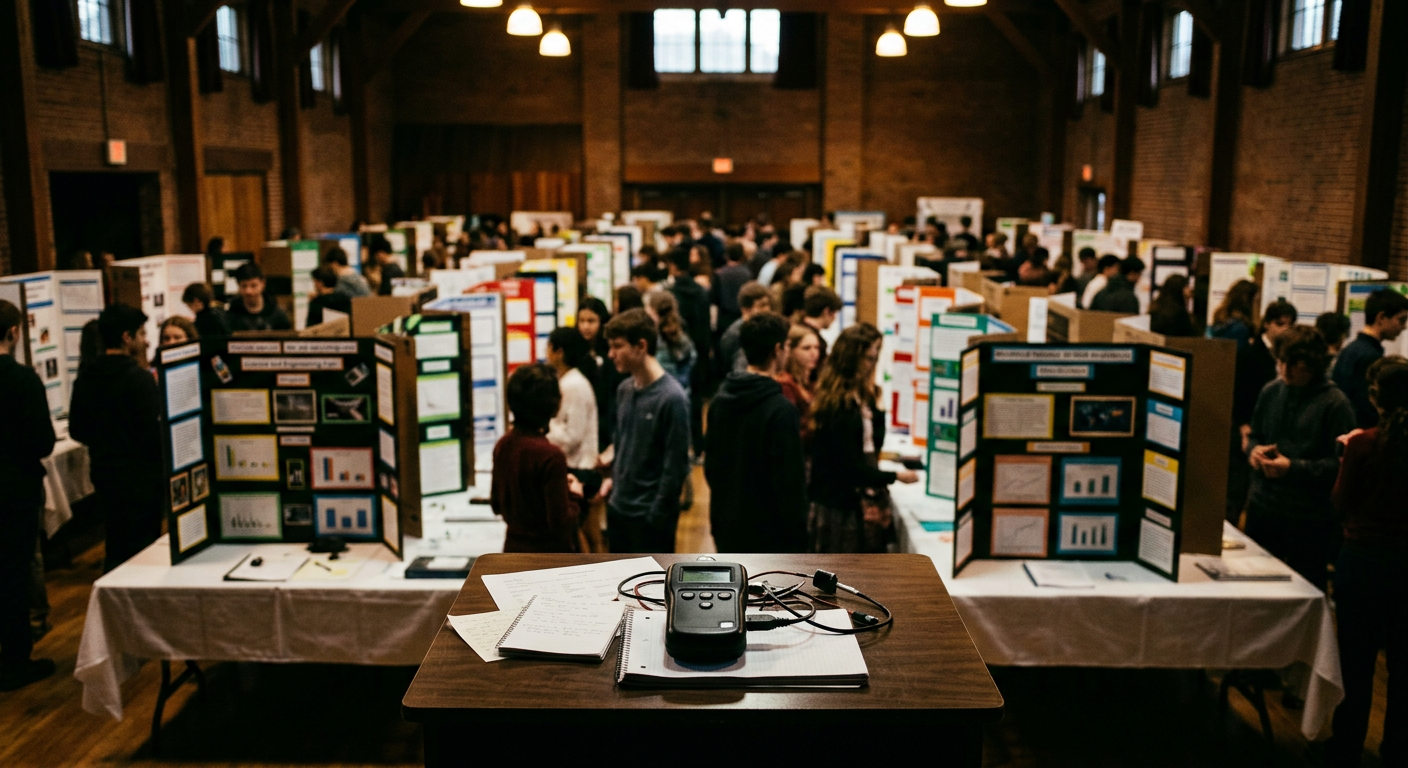
ONYX began as a student research project at the Orange County Science & Engineering Fair and advanced through the California State Science & Engineering Fair to the International Science & Engineering Fair — now entering formal peer review.
01Research lineage
From OCSEF to ISEF.
Stage 01 · Regional
OCSEF
Orange County Science & Engineering Fair
The project originated as a question about why asthma is still monitored episodically. The first ONYX prototype and initial airflow experiments were presented to regional judges, establishing the research direction.

Stage 02 · State
CSEF
California Science & Engineering Fair
Advancing to the state level, the work expanded from a single sensor into a connected system, introducing environmental context and the first iterations of the AsthmaNET modeling approach.

Stage 03 · International
ISEF
Regeneron International Science & Engineering Fair
At the international level, ONYX was presented as a multimodal research platform spanning hardware, cough acoustics, and genomic features — the foundation for the manuscripts now in preparation.
Stage 04 · Now
Peer review & company formation
02Methodology
Rigor as a design constraint.
Our approach follows the conventions of biomedical engineering research: defined questions, controlled evaluation, and reporting that separates what is known from what is still being tested.
- M1
Hypothesis-driven design
Each development cycle begins with a defined research question and pre-specified evaluation criteria.
- M2
Benchtop characterization
Airflow hardware is evaluated against reference flow conditions to quantify repeatability and measurement error.
- M3
Multimodal data alignment
Airflow, environmental, acoustic, and genomic data are synchronized on a common timeline with documented provenance.
- M4
Rigorous model evaluation
Models are assessed on held-out data with subject-level splits to reduce leakage and overstated performance.
- M5
Transparent reporting
Findings are reported with their limitations and submitted for independent peer review.
03Validation & technical achievements
What we have shown — and what we are still testing.
- Verified
Functional connected prototype
A working ONYX device capable of capturing forced expiratory maneuvers and transmitting session data.
- Verified
Expert review at regional, state, and international levels
Research presented and evaluated by judging panels at OCSEF, CSEF, and ISEF across a five-year program.
- Verified
AsthmaNET multimodal architecture
Design and implementation of encoders and a cross-modal fusion framework for four data modalities.
- In progress
Device measurement validation
Systematic comparison of ONYX airflow measurements with reference instrumentation.
- In progress
Predictive performance of AsthmaNET
Evaluation of model performance on larger, independent cohorts. No clinical predictive claims are made at this stage.
- Planned
Prospective human-subjects studies
IRB-reviewed studies to assess usability and real-world measurement behavior.
04Publications · In peer review pipeline
Submitting to the journals that set the standard.
The following manuscripts are in progress. Their content has not yet been accepted or published, and journal names indicate target venues only — not endorsement.
- Submission in progress

IEEE JBHI
IEEE Journal of Biomedical and Health Informatics
AsthmaNET multimodal architecture and the computational methods for fusing airflow, environmental, acoustic, and genomic data.
- CHESTSubmission in progress
CHEST Journal
CHEST
Clinical rationale for continuous connected peak-flow monitoring and its potential role in asthma control assessment.
- naturebiomedical engineeringSubmission in progress
Nat. Biomed. Eng.
Nature Biomedical Engineering
Design and engineering of the ONYX airflow sensing platform as an integrated device-to-model research system.
Review the work. Challenge it. Build on it.
We welcome scientific collaborators, reviewers, and institutions interested in independent validation.